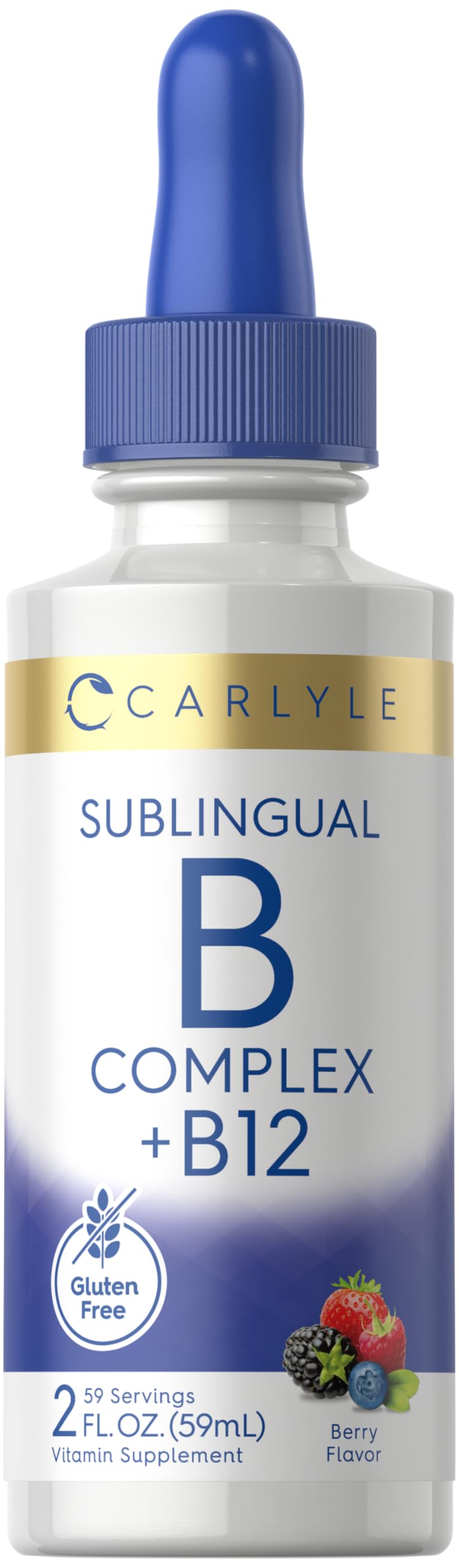
This liquid B-complex provides five B vitamins in a sublingual format — you hold it under your tongue for 30 seconds before swallowing. **Vitamin B12** at 1,200 mcg is the main draw, falling within the clinically researched range of 250–5,000 mcg. Sublingual delivery helps B12 reach your bloodstream more directly, which matters if you have reduced stomach acid (common in adults over 50). The other B vitamins — **riboflavin**, **niacin**, **vitamin B6**, and **pantothenic acid** — all land near basic daily values but below therapeutic ranges.
The B12 uses cyanocobalamin, a synthetic form your body must convert before using it. This works fine for most people, but a methylated form would be more direct. **Riboflavin** is provided in its active form, which is a quality choice even at a modest dose. Niacin comes as niacinamide, which avoids the flushing side effect.
This is an incomplete B-complex: it's missing **thiamine** (B1), **folate** (B9), and **biotin** (B7). If your main goal is sublingual B12, the 1,200 mcg dose is reasonable. But if you want full B-complex coverage, you'll need a product with all eight B vitamins.
BioStacks
Best for
Ingredients (5)
Pantothenic Acid
60%Dose
30 mg
Target
50–500 mg
Form
—
Vitamin B6
8%Dose
2 mg
Target
25–100 mg
Form
Premium
Niacin
80%Dose
20 mg
Target
25–500 mg
Form
Standard
Riboflavin
7%Dose
1.7 mg
Target
25–100 mg
Form
Standard
Vitamin B12
100%Dose
1200 mcg
Target
250–5000 mcg
Form
Budget
Other Ingredients (3)
SorbitolSweetener
A FODMAP sugar alcohol that may trigger GI discomfort (bloating, gas) in individuals with IBS or sorbitol malabsorption, even at small amounts found in supplements. Avoided in low-FODMAP diets.
Purified WaterSolvent
Water meeting USP specifications used as solvent/vehicle in gummies and liquids
GlycerinHumectant
Sweet-tasting liquid used in soft capsules and liquids
How to Take It
Best taken in the morning
Many people prefer B-vitamins earlier in the day; take with food to avoid nausea.
With food
On the label
Directions: Shake well before use. For adults, place one (1) mL (cc) under the tongue and hold there for 30 seconds before swallowing, up to four times daily.
General guidance based on the ingredients, not a substitute for the label or your doctor.
Price Check
$7.58
Cheaper than 98% of 239 energy supplements
Track this supplement in your stack
Get personalized insights, interactions, and coverage recommendations.
Get Started FreeSimilar Supplements
Sources & Scoring
Nutrient data (RDA, UL, and safety thresholds) sourced from the NIH Office of Dietary Supplements and the National Academies Dietary Reference Intakes (DRI).
This is not medical advice. Consult a healthcare provider before making changes to your supplement routine.
The score analyzes what's on the label: ingredient doses vs. studied ranges, chemical forms, evidence levels, and known interactions. It does not verify label accuracy or test for contaminants — for that, look for third-party certifications like USP or NSF.