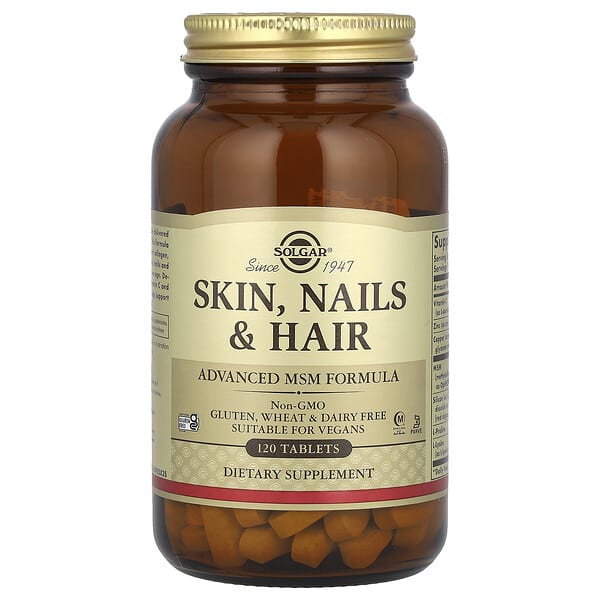
The headline ingredient here is **MSM** (OptiMSM), dosed at 1,000mg — right at the minimum of the 1,000–3,000mg clinical range. OptiMSM is the most studied branded form, purified by distillation, so you're getting a legitimate dose of bioavailable sulfur to support keratin production and connective tissue health.
**Zinc** at 15mg (citrate form) sits at the bottom of the studied range, and the inclusion of 2mg **Copper** in a well-absorbed glycinate form is a smart functional pairing — zinc depletes copper over time, and this product accounts for that. **Vitamin C** at 120mg supports collagen synthesis, though it falls well short of the 250mg+ range used in clinical research.
The weak spots are the amino acids. **L-Proline** and **L-Lysine** are each dosed at just 50mg — roughly 10% and 5% of their respective studied ranges. At these amounts, they're contributing very little toward collagen building. **Silicon** is listed at 50mg, but it's in the silicon dioxide form, which has minimal oral bioavailability. If you're buying this for skin and hair support, the MSM is doing the heavy lifting — the supporting cast is largely underdosed.
BioStacks
Best for
Ingredients (7)
Copper
100%Dose
2000 mcg
Target
1000–2000 mcg
Form
Premium
MSM
100%Dose
1000 mg
Target
1000–3000 mg
Form
—
Zinc
100%Dose
15 mg
Target
15–30 mg
Form
Standard
Vitamin C
48%Dose
120 mg
Target
250–2000 mg
Form
Budget
Silicon
100%Dose
50 mg
Target
5–30 mg
Form
Budget
Other Ingredients (5)
Magnesium StearateLubricant
A salt of stearic acid used as a lubricant in tablet and capsule production
Microcrystalline CelluloseBinder
Plant-derived cellulose used as a binder and filler in supplements
Microcrystalline CelluloseBinder
Plant-derived cellulose used as a binder and filler in supplements
GlycerinHumectant
Sweet-tasting liquid used in soft capsules and liquids
Stearic AcidLubricant
Saturated fatty acid used as tablet lubricant
How to Take It
Take it anytime
Timing doesn't matter; take it with food if it upsets your stomach.
With food
Lysine does better on an empty stomach, but something else in this bottle needs food. Taking the whole product with a meal is the better trade — an upset stomach is why most people stop.
Space it a couple of hours from Iron and Calcium
General guidance based on the ingredients, not a substitute for the label or your doctor.
Price Check
$11.19
Cheaper than 89% of 66 MSM supplements
Track this supplement in your stack
Get personalized insights, interactions, and coverage recommendations.
Get Started FreeSimilar Supplements
Sources & Scoring
Nutrient data (RDA, UL, and safety thresholds) sourced from the NIH Office of Dietary Supplements and the National Academies Dietary Reference Intakes (DRI).
This is not medical advice. Consult a healthcare provider before making changes to your supplement routine.
The score analyzes what's on the label: ingredient doses vs. studied ranges, chemical forms, evidence levels, and known interactions. It does not verify label accuracy or test for contaminants — for that, look for third-party certifications like USP or NSF.