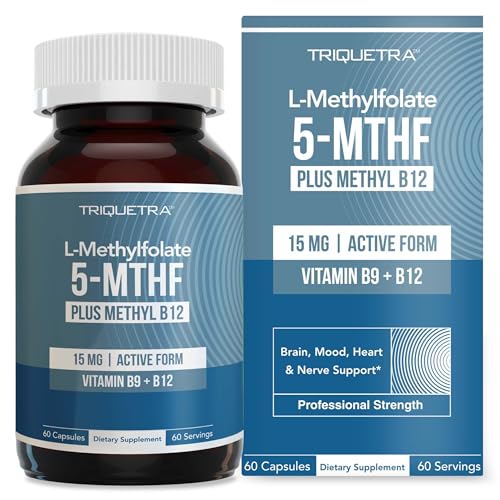
This pairs a full 800mcg of active **folate** as methylfolate (listed as 1,333mcg DFE) with 800mcg of active **B12** as methylcobalamin — both in the ready-to-use forms that skip the MTHFR conversion step the roughly 40–50% of people with that gene variant handle poorly. At those doses you're comfortably within the ranges that support energy and healthy red-blood-cell formation.
Combining these two is the responsible call rather than dosing either one alone. Folate and B12 work side by side in methylation and blood-cell production, so a shortfall in one limits what the other can do. It also closes a real safety gap: high-dose folate on its own can mask the blood signs of a B12 deficiency and let nerve damage progress unnoticed, which the 800 mcg of B12 here prevents.
At one capsule you're already at a full dose, with room to take two daily if you're correcting a documented deficiency or working down elevated homocysteine. The folate sits right at the top of its typical 400-800 mcg range, and the B12 runs far above the 2.4 mcg daily requirement — generous on purpose, since B12 absorbs poorly and benefits from a wide margin. This is a targeted top-up for people with a genuine methylation need or low B-vitamin status, not an everyday baseline.
BioStacks
Best for
Ingredients (3)
Folate
100%Dose
1333 mcg DFE
Target
400–800 mcg
Form
Premium
L-5-MTHF
100%Dose
800 mcg
Target
400–800 mcg
Form
Premium
Vitamin B12
100%Dose
800 mcg
Target
250–5000 mcg
Form
Premium
Other Ingredients (3)
Ascorbyl PalmitateAntioxidant
Fat-soluble form of vitamin C used as preservative
Hypoallergenic Plant FiberFiller
Plant-derived cellulose fiber used as a hypoallergenic filler, common in Thorne and Pure Encapsulations products
Capsule ShellCapsule
Generic capsule shell where the label does not specify the material. Common materials are hypromellose (HPMC) for vegetarian capsules and gelatin for traditional capsules — both are GRAS-listed and safe. Fish gelatin and pullulan variants also exist.
How to Take It
Best taken in the morning
Many people prefer it earlier in the day; there's no evidence timing changes anything. Absorption is fine with or without food.
With or without food
On the label
As a dietary supplement, take 1 capsule, 1-2 times daily, with meals.
General guidance based on the ingredients, not a substitute for the label or your doctor.
Price Check
$20.60
Near the median of 138 vitamin B9 supplements
Track this supplement in your stack
Get personalized insights, interactions, and coverage recommendations.
Get Started FreeSimilar Supplements
Sources & Scoring
Nutrient data (RDA, UL, and safety thresholds) sourced from the NIH Office of Dietary Supplements and the National Academies Dietary Reference Intakes (DRI).
This is not medical advice. Consult a healthcare provider before making changes to your supplement routine.
The score analyzes what's on the label: ingredient doses vs. studied ranges, chemical forms, evidence levels, and known interactions. It does not verify label accuracy or test for contaminants — for that, look for third-party certifications like USP or NSF.