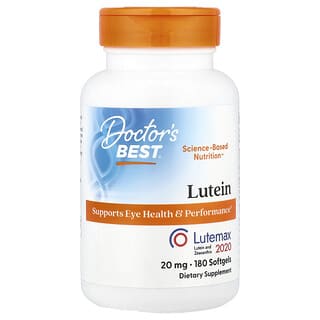
This **Lutein** and **Zeaxanthin** softgel delivers 20mg and 4mg per day — double the amounts used in the AREDS2 trial — to support macular health and protect your eyes from blue-light damage as they age. Both carotenoids build up in the macula, the part of your retina responsible for sharp central vision, where they filter high-energy light and act as antioxidants. At these doses you're well past the studied effective range of 10mg lutein and 2mg zeaxanthin, so one daily softgel covers you fully.
The two complement each other rather than overlap: lutein settles across the outer macula while zeaxanthin concentrates at the fovea, your point of sharpest focus, together giving complete macular pigment coverage. This is the exact pairing AREDS2 tested in over 4,200 people for reducing the risk of age-related macular degeneration. Because both are fat-soluble, the coconut and sunflower oil base helps absorption — taking it with food, as the label directs, helps you get the full dose.
If you're after long-term vision protection — especially with heavy screen time or a family history of macular degeneration — this gives you a complete, well-studied dose in a single softgel, with no need to take more than the recommended serving.
BioStacks
Best for
Ingredients (2)
Lutein
100%Dose
20 mg
Target
10–20 mg
Form
—
Zeaxanthin
100%Dose
4 mg
Target
2–4 mg
Form
—
Other Ingredients (3)
Coconut OilCarrier
Edible oil from coconut used as a release/anti-sticking agent and carrier in gummies and soft formats
Capsule ShellCapsule
Generic capsule shell where the label does not specify the material. Common materials are hypromellose (HPMC) for vegetarian capsules and gelatin for traditional capsules — both are GRAS-listed and safe. Fish gelatin and pullulan variants also exist.
Sunflower Seed OilCarrier
Common vegetable oil from sunflower seeds used as a carrier in softgels for fat-soluble nutrients
How to Take It
Take it anytime
Fat-soluble — take with a meal containing fat for better absorption. Time of day doesn't matter.
With a meal containing fat
On the label
Adults take 1 veggie softgel daily with food, or as recommended by a qualified healthcare professional.
General guidance based on the ingredients, not a substitute for the label or your doctor.
Price Check
$23.97
Near the median of 76 lutein supplements
Track this supplement in your stack
Get personalized insights, interactions, and coverage recommendations.
Get Started FreeSimilar Supplements
Sources & Scoring
Nutrient data (RDA, UL, and safety thresholds) sourced from the NIH Office of Dietary Supplements and the National Academies Dietary Reference Intakes (DRI).
This is not medical advice. Consult a healthcare provider before making changes to your supplement routine.
The score analyzes what's on the label: ingredient doses vs. studied ranges, chemical forms, evidence levels, and known interactions. It does not verify label accuracy or test for contaminants — for that, look for third-party certifications like USP or NSF.