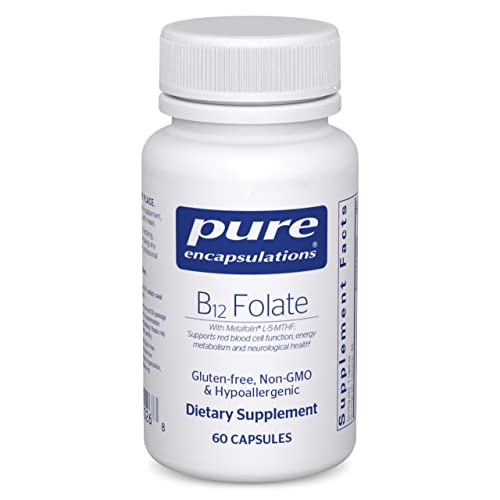
This two-ingredient capsule delivers folate and B12 in their already-active forms at doses that hit clinical ranges for energy, methylation, and healthy red blood cell production. You're getting **folate** as L-methylfolate at 680 mcg DFE — about 400 mcg of actual methylfolate, since methylfolate counts as roughly 1.7x its weight in DFE — in the form your body can use directly, with none of the conversion step that synthetic folic acid requires. That matters for the 40–50% of people carrying MTHFR gene variants, who convert standard folic acid poorly: here you skip that bottleneck entirely and get folate your cells can actually put to work.
**Vitamin B12** comes as methylcobalamin at 300 mcg, again an active form you use straight away, sitting comfortably within the 250–5,000 mcg range supplements use to overcome low absorption. Pairing the two is the responsible design rather than a marketing flourish: folate and B12 work side by side in methylation and red blood cell formation, and taking high-dose folate on its own can mask a developing B12 deficiency. Delivering both together closes that gap.
This is a strong fit if you're vegan, over 50, planning a pregnancy, or know you carry an MTHFR variant — all groups where one or both of these nutrients run low or convert poorly. At one capsule daily with both in ready-to-use form, you reach an effective intake without guesswork.
BioStacks
Best for
Ingredients (2)
Folate
100%Dose
680 mcg DFE
Target
400–800 mcg
Form
Premium
Vitamin B12
100%Dose
300 mcg
Target
250–5000 mcg
Form
Premium
Other Ingredients (3)
Dicalcium PhosphateBinder
Calcium and phosphorus compound used as binder
Microcrystalline CelluloseBinder
Plant-derived cellulose used as a binder and filler in supplements
Microcrystalline CelluloseBinder
Plant-derived cellulose used as a binder and filler in supplements
How to Take It
Best taken in the morning
Many people prefer it earlier in the day; there's no evidence timing changes anything. Absorption is fine with or without food.
With or without food
On the label
Take one (1) capsule daily, or as recommended by a healthcare practitioner.
General guidance based on the ingredients, not a substitute for the label or your doctor.
Price Check
$15.93
Near the median of 138 vitamin B9 supplements
Track this supplement in your stack
Get personalized insights, interactions, and coverage recommendations.
Get Started FreeSimilar Supplements
Sources & Scoring
Nutrient data (RDA, UL, and safety thresholds) sourced from the NIH Office of Dietary Supplements and the National Academies Dietary Reference Intakes (DRI).
This is not medical advice. Consult a healthcare provider before making changes to your supplement routine.
The score analyzes what's on the label: ingredient doses vs. studied ranges, chemical forms, evidence levels, and known interactions. It does not verify label accuracy or test for contaminants — for that, look for third-party certifications like USP or NSF.